Friday, January 28, 2011

DIY ornament Roundup: top 5

Are the kiddos are at home and in need of entertainment? - making ornaments is a fun way to spend time together. Get involved as a family, turn on some holiday tunes and have some creative time. If your tree is getting too full of ornaments, I'm sure Grandma & Grandpa and Aunties & Uncles would love some for their tree's too!


I first came across this ornament design by Noodle-Head.com "Half Eaten Ornaments". I love this take on making Gingerbread Man ornaments with a laughable approach. These will definitely be on my list for next years projects. One of the simple details here is using a red button with white yarn/string to make them look like peppermint candies. Genius! Original pattern by Elsie Marley here.


To be an ornament or present topper. I do have to admit, what I love about this one is that I can go dig in my son's Bug's & Creatures bin and get some plastic Dollar Tree dinosaurs or lizards. I think he'd be really amused with having dinosaurs, lizards and bugs on the tree. I think I'll opt for metallic spray paints (Rustoleum is excellent for plastics) and go for the single colour instead of the gold leafing because that's what I have on hand and it might be a lot cheaper not to mention LESS work, which I am a big fan of! This tutorial originated from papernstitch.com and is found in her free PDF Happy Holiday's Guide to DIY. I originally found this project shared from Brittni of papernstitch.com on CreatureComfortsBlog.com.


This one looks super easy and hassle free. Use any kind of paper scraps, mix it up, mess it up and have fun. Just takes a couple of beads, some string and paper. DIY by HowAboutOrange.Blogspot.com - DIY Striped Paper Ornament.


I love the concept here of using mini chalk boards and writing little positive notes or reminders of giving or cheer. The entire tutorial incorporates a lot more, but the basic concept here using balsa wood, chalkboard paint and some twine (add a shape star or other type of shape?) and you're good to go. You could have each kid write something on them too, then note the year and child's name and age on the back. DIY by A Lemon Squeezy Home (alemonsqueezyhome.blogspot.com) - "What Shall I Give Christmas Ornament Tutorial".


This totally brings back memories! I think that the whole Salt Dough Ornament idea has been around for ages. I believe my mom might still have ornaments that we made when we were kiddlets. This is the perfect ornament project for almost any age. I think I'll make some for a project on Christmas Eve for the kiddo's. We'll have two 2 1/2 yr olds who love dough. Not saying they'll make anything much with it, but it will still be fun. Start collecting shape cutters for next year! Salt Dough Recipe and ornaments pictured are by Prudent Baby (PrudentBaby.com) - Salt Dough Ornament DIY.


A note of warning for storing these: They are generally tough and hold their shapes but I would strongly suggest storing these in particular in a moisture-proof container such as a Tupperware container and pad each with a paper towel (or alternative soft cushy separator). One year our storage area got some moisture and some parts of these ornaments turned to mush and almost ruined other homemade ornaments in the same box. I would consider modge podging those the base layer after baking for a bit more durability and sealant.


I hope everyone has a safe and happy holiday!

mollybean.comMolly Bermea has been working as a freelance graphic and web design artist for the past eight years as MollyBean.com. She is also a traditional artist using many mediums, her favorite being oils and large scale paintings for which she does commercial and private contract pieces. Synchronizing color is something she has been quite addicted to all her life. Developing patterns has been a side affect to her artistic roots which she finds fun to incorporate with homemade cards, scrapbooking or her design pieces. She loves to eat healthy and leads an active lifestyle, training for triathlons and marathons. She has been married for five years and enjoys crazy hikes and adventures with her family, husband and their adorable two-year-old son who is of course going to be a genius when he grows up.

View the original article here

Monday, January 24, 2011

Winter snows of George Gardner Symons

For those in the United States and Europe out digging, or still fall into the Titan white and cobalt Blues winter precipitation, I'll relay, a gentle reminder from American artist George Gardner Symons, known for its beautiful winter scenes that Yes can snow also nice, and Yes, it finally melts and Yes, spring in fact come back some day.


For more information, including links to image resources, see my previous post on George Gardner Symons.


View the original article here

Sunday, January 23, 2011

Confident color

This is one of those books for which the binding is key.


Nita Leland sure color: artist's Guide to harmony and contrast of unity venerable art statement Publisher North light books is published.


Like his previous book, the new creative artist (which I reviewed here) and Bert Dodson's keys to drawing with imagination (my review here), North light which it published hardback/spiral binding, in your hybrid type overt clue that this a book to be used is rather then just read.


Table allowing hardcover for rough and continued operation allows the spiral binding for installation of the book flat on your drawing and the combination propping the book open upright on the track of an easel.


The intention of the Publisher is clearly being the writer to get the most from this book, worked with during which time must be used; and its best service if showed spattered ragged edges and color.


Not that you could settle in the comfy chair and read much interest by and look to find; Leland drills through a short introduction to color theory, history and terminology and covers the basics of understanding working pallets and pigments all augmented with your selection of works from a variety of contemporary artists and a few of their own. The real value, however, is the exercises, tests, procedures and processes that form the core of the book.


If you lucky occurred a teacher as Leland in your formative years, so can, who is however gentle and polite, continue to poke and prod and push you try something new, move you out of your comfort zone, experiment, play and explore.


This is not random try whatever experiment, however. in the safe color Leland guided exploration offers, designed, to systematically you with areas of relations represented by your color decisions familiar.


There is a preview "look inside" on the Amazon listing, although as often is the case, the pages represented the best reference to the actual content of the book type. The index is actually better for it.


The book is aimed at beginners and advanced artist and although Watercolour is mentioned his medium and some pigment General pallets with colors that work well on most media where color decorated are in watercolour.


In a sense, that this an extension of and companion to his 1998 has book exploring color is something of a standard books on working with color. The book was but without the benefit of the lay-flat binding, also worked with.


Both volumes focus alternately on the split primarily process of the blend and the study of the variations on the red/blue/yellow triads, which serve as a basis for several of the many possible color wheels.


Cautions you work with and understand the difference between pallets consisting subdued, intense and getönten earth colors and the "workhorse" colors that form the basis for most artist pallets.


In pursuit of their exercises and explorations, possibly using colours and combinations, you would ' t use in other circumstances, which may be counterproductive, productive; but just as contour drawing rarely is used as a finished work style, artists know with dedication, work be letting the practice to inform and strengthen your finished style.


This is not the kind of book that says, "Two parts CAD yellow to hand Ultramarine of this foliage paint mix"; in the safe color Leland, and really feel beats if you experiment harmony and contrast with these excursions in colour that blends possible work with variations of the primary triad for how colors to act and react with one another to get, you know instinctively what to mix if you want to paint something.


The book is binding is the key. Confidence comes from doing.


View the original article here

Winter Garland DIY: Gingerbread Bunting from recycling bags

This is a perfect way to dress up your home for the holiday and overwhelm may even okay until January. You can include the children! Rather than real, edible gingerbread men make up them and let you decorate with puff paint (aka "frosting"). You can also add embellishments such as buttons, Ribbon, and Rick rack, give you a little extra cuteness. Stick to just any extra's.


-Gingerbread man template (two sizes are in the PDF template and instructions download)
-Large brown paper grocery bags
-String, twine, ribbon or raffia swag
-Etwas for tracing. White chalk would like to use. If something permanent trace not result page use.
-Nähmaschine (although hand stitch could be anyone, it would be a lot of work!)
Filling (100% polyester Edition - any cheap)
I use-Puff paint - mainly white, but that is your prerogative
-Optional embellishments: Rick rack, Ribbon, lace, buttons... etc..


Paper bags: Cut in the middle of one page (on the fold). Then cut to/from the bottom of the bag and discard.


Templates: If you are using a permanent marker/pen, trace on the printed side of the paper, so that it not appear if you them together. I personally like, white chalk and trace directly to the result page use. I also track and cut out a little thicker than the template.


Track as many as you can fit, reverse the pattern to better customize. You need two cut-outs for each final gingerbread man.


Use two snippets - plain side out - layer one, then some filling, the second pane (place cotton). You want to keep the cotton from the edges a bit. Pin-about the snippet sandwich together, to keep the cotton in and the place while sewing. Now the edges with white thread attaching to (or whatever you want whatever color) approximately 1 / 4 "seam." Sewing will show so playing with a zig-zag stitch or straight or even some decorative stitching. Keep in mind that you will make many of these are it change if you want to. Before the sewing, see section "HANG" (Next).


There are a few methods to hang the Bunting (option "a" or "b" are easiest and my choice):

a) make all men have cut your string full length you want it to be and then glue it hot on the back of men.b) cut lengths between individual men, knot each end and then at the "fingertips" WHILE the men together sew sewing should be.c) cut to string in its entirety, was on the inside (sewing on the chest and "Fingertips" BEFORE.)


That's it! You can easily customize these patterns and the idea of substance for the gingerbread men or even do other shapes, such as Christmas tree's or snowmen. You could even mix it up and include many different forms on a string of the Emberizidae.


f you want to keep this project around or want the templates here is PDF template and instructions (gingerbread men Bunting) for printing.

mollybean.comMolly Bermea works as a freelance graphic and Web design artists for the past eight years as MollyBean.com. It is also a traditional artists who does painting for you, commercial and private contract with many media, your pet, oils and large scale pieces. Synchronize color, is something that was quite addicted to her life. Development pattern was one page influence to their artistic roots finds fun with homemade cards, scrapbooking or their design pieces to take. She loves to eat healthy and lead an active lifestyle, training for triathlon and Marathon. She has married for five years and enjoys crazy walks and adult adventure with her family to be husband and your adorable two-year-old son, who of course is when he is a genius.

View the original article here

Adoration of the shepherds, Charles Le Brun

Charles Le Brun was an important figure in 17th century French painting. Shows here in his adoration of the shepherds (also here), he his skills with composition, colour and light with you to gently lead our eyes through various aspects of a complex scene.


The immediate focus of course, is your illuminated numbers by the dark outline the foreground accentuated characters on the mother and the child. Then our eye sweeps upwards through the corners of the angelic banner with the rising smoke, in the heavens have opened in our scene. If we again have to pay, in the foreground we a wealth of other numbers, earthly and ethereal, which to focus on.


Le Brun's rich blues and deep orange-red balance and complement each other very nice, strengthening the path of our eye and give the painting a vivid, vibrant characters in total.


View the original article here

Multi polar projects: 4 identities single art collective - interview


ITSOKCOLORWAY of polar multi on Vimeo.


Matthew Hoffman, it's all about identity. To the casual to the outside view is he a 9-5er, an artist oriented young guy, some As...shhhh probably unknown.... a career. But over distance running multi polar projects, a rep home for artists Sighn, H. Mathis, Ervin Orion and Mateo. Pursing an art collective of four dudes own separate work. Is the bad ass alone, but everything is reportedly very straight forward, until you learn the entire multi polar projects crew is only one person. Hoffman. Then the question is where is the artist and if the person is? And also like? Und.Wann happens sleeping?


It's not really a question, need answering, it is enough proposition on its own a magnificent. It has only the only way Hoffman his know how they seem to be an artist. It is deeply rooted in his trial and can not be teased.


Better yet? He is a new project delete silence after one year art making.


Sighn's work the moniker responsible, in his typical only text emotive style. ITSOKCOLORWAY is the Rainbow hued Edition of his ongoing ITSOKAY-project. As the Tweeps and Facespaces erupt after the campaign in Internet obscurity zipping goes with millions of electronic blurbs per day and viral campaign, he is busy carving pithy jokes made of wood with a lifelong goal of 1 million wooden ITSOKs. A permanent snap shot of communication from materials that once grew in the soil is forged. You should have a cyborg to Feeeeeeelings part sculpture, part talisman, everything delicious typography and wordplay, include in the work.


I shot to answer a request to some light-hearted interview questions Sighn, and what followed was projects an extensive back and forth between me, Sighn, H. Mathis and multi polar. Hilarious, because Hoffman all parts of separate addresses to play funny in itself all the time. At the end of it as a snarky not-so-subtle and completely unintended ended, jab at long annoying e-Mail chains. Oh stars and pantyhose children, this email his artistic (meta) mean in fact... For these designers, bloggers and typography geek is that the black hole of perfect.


So here you go: H. Mathis illustrated responses to Sighn's interview questions. By Matthew Hoffman. I think.


I think this is what I call an artist is reinventing. Old school of new school. And there are no tells how far this child can go. It is chaos! Mania! It is usually BRO. someone please save me from me, before it is ecstatic-induced vomiting as the child in Adam Sandler of Big Daddy.


Learn more and order your own piece. ITSOKs come in 10 colors plus natural unfinished bamboo or Basswood. $20 each.

http://www.pitchdesignunion.com/Margot is a graphic designer, art junkie and all-round collaborator bound by anything and do. Her friends include Oldstyle figures, antique books and dusty suitcase, bicycle tours and old wacky electronics. If you do not design it does odd jobs and art papers and design on the Internet at http://www.pitchdesignunion.com/

View the original article here

Saturday, January 22, 2011

Jake Baddeley

Jake Baddeley is little information about yourself on his site save itself call, a painter and artist.


Search through his work, I see training of the surrealists classical influences and magic realist and a fascination for the art and the invention of the Renaissance.


It uses a subdued, controlled range with passages of restrained but rich color, and his compositions often feeling deliberately arranged Tableaux with questions and comments from meaning scattered through the topics. Often there are objects, the floating either frozen movement or defiance of gravity, and repeated issues of masks, blindfolds and curtains suggesting subliminal importance.


The painting on his website are organized by year, the sections for a click-through-navigation of and no thumbnails contained, although there are. It is also a gallery of drawings in the "more work" section.


Find a selection of his paintings in the Ten dreams Gallery in an arrangement that gives an overview of his work more easily. There are galleries of his paintings to the leg style surreal art collective and imaginary realism art print site.


Prints his work are directly about his Web Shop. Editions of a book called dreamscapes this feature a number of artists including Baddeley in the 2009 and 2010 volumes both his business and the imaginary realism website are available.


View the original article here

Convenience stores: Winning customers with color

Green, orange, red and white color palette of 7-Eleven dominates the convenience store market anywhere in the world. It is the world's largest operator, franchisor and licensor of convenience stores with more than 39,000 Sockets (even more than McDonald's).


While it probably the biggest role in attracting customers plays where are various shops in such close proximity to each other, these transactions in a market like saturated than convenience stores, convenience, not color, it's worth look at these stores color identities and think like the color perception having a wide range can affect many things like clean, efficiency, products, and other ways you might want to distinguish a company. Or, simply, used as colour can attract attention.


Convenience store color palettes do a very good job attention. Their bright colors contrast the gray tones of city blocks, suburban parking and rural intersections throughout the world, and the colors most used: red, yellow, orange and blue.


Can your own style of customers in this 7-Eleven and / PM Colorways by newbalance attract.


Header image Kiss Detroit. Daily store photo of Yuya Tamai.

http://www.colourlovers.com/David Sommers has colour COLOURlovers' blog editor in Chief for the last two years have been loving. If it is not neck deep in a rainbow is he other things with the post family (http://thepostfamily.com/), a Chicago-based arts blog, artist collective & Gallery to love.

View the original article here

Ian McQue

Ian McQue is a concept artist, Illustrator and Director of the gaming industry. He currently works for Rockstar North and gaming fans recognize the multiple Grand Theft Auto title to his credit, along with a number of others play.


McQue works in both traditional and digital media, the latter including Photoshop, Illustrator and 3d Studio Max.


If you are not working McQue of his flotilla steampunk like airships to add. Beautifully realized, incredibly hard, smash and appear patched as if the antenna could be recovered and the junks equivalent ships to turn off the map Pacific port, trade with God knows what, plying the currents in the gray sky somewhere else or another time.


A beautiful large introductory batch of flying ship, please visit concept ships, where his work monthly header was chosen for this month.


See more of it on his blog, along with some of his beautiful gestural sketches. There is also a gallery on CGHub.


[Via io9]


View the original article here

Friday, January 21, 2011

Technicolor fashion: Marie Antoinette

Once a month, we'll be taking a look at fashion in film--characters, colors and costume design. Working together to create a believable persona, in the movies, the clothes often quite literally make the man. Or, in the case of today's character, they make the 18th-century queen-to-be.


Director Sofia Coppola's 2006 Marie Antoinette is loosely based on the real life of its title character, the Archduchess of Austria who married Louis-Auguste, the Dauphin of France, in 1770 at the age of 14. In history and in the film, the marriage isn't consummated--a sticking point in the story. Instead, Marie (portrayed by Kirsten Dunst), who has little political sway and finds herself frustrated with life at court, throws herself into more frivolous pleasures--clothing, gambling and makeup. When the king of France passes in 1774, the Dauphin (portrayed by Jason Schwartzman) becomes king--making Marie Antoinette the new queen.


 Marie's extravagant lifestyle and her husband's investment in foreign wars are cause for unpopularity in debt-ridden France. Marie's brother, the Holy Roman Emporer Joseph II, comes to visit, counseling Marie to scale back her ways and giving the king advice on bedroom matters. Seven years after it happened, the marriage is finally consummated; Marie gives birth to her first child, a girl, in 1778.


In the film, Marie begins an affair with Swedish Count Axel von Fersen and begins to spend much of her time at a small chateau on the grounds of Versailles. She has a son, the new Dauphin of France, and begins to spend more time focusing on her family--and less on gambling and purchases, particularly in light of France's fiscal problems, which cite regular riots. At the end of the film, the the royal family leaves Versailles for Paris as the French Revolution grips the country.


 While Marie Antoinette's modern flairs--highly stylized characters, a mostly contemporary soundtrack--draw criticism, the title character's lavishness is beautifully captured. The film is something to look at, and that's in large part thanks to Italian costume designer Milena Canonero, who won an Academy Award for her work on Marie Antoinette.


According to an article in The London Times, "At the start of pre-production, Coppola handed Canonero a box of pastel-coloured macaroons from the Ladurée pastry house. 'She told me, 'These are the colors I love',' recalls Canonero. 'I used them as a palette. Sofia was clear about the coloration, but left the rest to me. We squeezed the essence of the period, without reproducing it. Even if you think you know a lot about it,' she argues, 'you always have to look for a new angle. I simplified the very heavy look of the 18th century. I wanted it to be believable, but more stylized.'


 Canonero said she'd start each of Dunst's frothy, frilly, candy-colored pieces by throwing material over the actress to see which colors best suited her. Wigs were rarely used for Dunst, Canonero said, because they weren't right for her. The majority of the clothes were made in ateliers in Rome's Cinecitta studios, considered the hub of Italian cinema.


It's not surprising that Canonero's biggest challenge was the volume of costumes, especially those required for the film's three opera scenes (Marie Antoinette was a performer),  the wedding, the Dauphin's coronation, and the gambling and party scenes. In a string of the latter, dresses, baubles, accessories, shoes (by designer Manolo Blahnik), and sweets (by Ladurée) are piled, frame by frame, and set to a remix of Bow Wow Wow's "I Want Candy":


"Sofia’s portrait of Marie Antoinette in the film is accurate, but human," Canonero told the Times. "To me, Marie Antoinette was very unlucky. She lacked the right upbringing for such a role. She was the sweet playful girl of the family. Sofia has grasped the lightness and superficiality of the young Marie Antoinette, but also the dignity of the woman. She has done it by using light brush strokes and not too much dialogue."


Coppola said herself the point of the film, rather than historical accuracy or even a much-detailed story, was to focus on Marie Antoinette's "personal story": "Louis wouldn’t sleep with her, so she wanted to go out and party--like someone in a bad marriage going shopping. It just seemed like the same old story," she told the New York Times.


In relation to Coppola's two previous films--The Virgin Suicides (1999) and Lost in Translation (2003)--she said she saw Marie Antoinette as the last in a triology. "It’s a continuation of the other two films--sort of about a lonely girl in a big hotel or palace or whatever, kind of wandering around, trying to grow up," she said. "But in the other ones, you know, they’re always sort of on the verge. This is a story about a girl becoming a woman. And in this, I feel like she does."


And perhaps, considering in real life, Marie went on to have four children to whom she was greatly dedicated, as well as an increased amount of political influence, that's not entirely inaccurate.


Screencaps courtesy Screenmusings.org.

onlystyleremainsthesame.blogspot.comLindsey Baker is a style columnist based in Omaha, Neb. Check out her personal style blog, only style remains the same, at http://onlystyleremainsthesame.blogspot.com, or follow her on Twitter at http://twitter.com/shoptalkomaha.

View the original article here

Interior design trends: pink and gray

http://www.colourlovers.com/Olan is the founder and owner of Ofifteen, a design consultancy located in New Jersey. Married and proud mother of three, olan manages to keep both your family and your customers happy. Centenary College graduated in 2001 with a BFA in interior design and really loves what does.

View the original article here

Interview with Jean-Baptiste Monge


Jennifer was kind enough to write and let me know that you have a two-part interview with French fantasy Illustrator and concept artist Jean-Baptiste Monge has posted (, which I previously profiled here) on your blog Academy of art character and creature design notes.


An interview with Jean-Baptiste Monge, part 1 and part 2.


The blog is aimed at students of the Academy of Art University but Oliver has generously shared the interview with the rest of us.


The interview is conducted in English, abundant beautiful Monge's often detailed and wonderful paintings realised together with drawings, sketches and photos of Monge the work (make sure to click on the images for larger versions) illustrated (how I love that phrase).


Monge's work is charming, in the full sense of the word you in draw with beautifully stylized lines and shapes, and then charming touches the eye with beautiful and thoughtful details. He reminds me often illustrators of the golden age of illustration just before and after the turn of the century, so I found the list of influences mentioned it in an interview of particular interest.


He mentioned I did not expect a number of artists and illustrators I would have linked to it from my impression from his style, and some who.


Many of the artists he mentioned were the subject of the earlier posts on lines and colors, including painter and Clsssic illustrators such as W. Waterhouse, Jean-Léon Gérôme, John Bauer, Edmund Dulac, Arthur Rackham, Alphonse Mucha, Norman Rockwell, j. c. Leyendecker Haddon Sundblom and contemporary illustrators such as John Howe, PJ Lynch and James Gurney (links to my posts).


Oliver some resources information on Monge, including its website, a portfolio lists creative talent network, his LinkedIn and Facebook pages and Mr Dumblebee.


For more see my previous post about Jean-Baptiste Monge.


View the original article here

Wikimedia Commons


No, it have to do with WikiLeaks, but Wikimedia Commons is familiar with other wiki related phenomenon, Wikipedia, on the basis that both projects of the Wikimedia Foundation.


(A wiki, by the way, a kind of Web site, especially a potentially collaborative site is easy created using wiki software allows you to post, edit and manage people without knowledge of HTML.)


Wikimedia Commons is the Wikimedia Foundation's online free-use media resource over 7,000,000 media - sound, video and of course, pictures.


Among the images of art relating to images - paintings, drawings, etchings, engravings and the like are always more. It has become one of the larger art image repositories on the Web (see my posts on the Athenaeum, ArtMagick AllPaintings Web Gallery of Art, The art renewal Center). You may have noticed links to Wikimedia Commons under the links with a number of my articles about artist from history.


Can the search function above on each side of Wikimedia Commons to locate a particular artist, of course, but one of the beautiful things about the arrangement of the material is that allows a specific type of search, a conducive to artists and works to discover may be new for you.


An initial search for "paintings", brings a page, access other category listings such as paintings of the artist, painting by city, country, period, medium, subject, offers technology and even painting Museum.


One of the most productive in my opinion is "painting by date" category, and from this landing, "paintings of century".


Here it is easy to restrict such as 19 paintings. At this level you are presented with a number of thumbnail images for a variety of paintings of the century, a kind of skim through some of the century's decades artists and a further breakdown. Here's where I to search, by you a decade ago, such as paintings of the 1880s.


Although there is more pressure at this level in each year, the thumbnails for a present particular decade a nice varied selection of works indicate to an array of artists. Although hardly comprehensive makes it a fun way to explore and a selection works by artists both familiar and not.


The images above, for example, all represented on the 1880s paintings page as thumbnails, from top: James Tissot, Henryk Siemiradzki Hector, Carl Spitzweg, Alexander Novoskoltsev, Vincent van Gogh, Willem de Zwart, John Singer Sargent, Jules Euge Ollone, Ilya Repin, Jean-Léon Gérôme, Edouard Manet, William Merritt Chase.


Click once on the page for a single work you sometimes (but not always can) through a linked mention of the name of the artist in a page of works specially that artists such as William Merritt Chase.


The possibilities for artists discover are extensive.


I give my usual major Timesink warning for this great resources and potentially addictive.


Enjoy!


View the original article here

Thursday, January 20, 2011

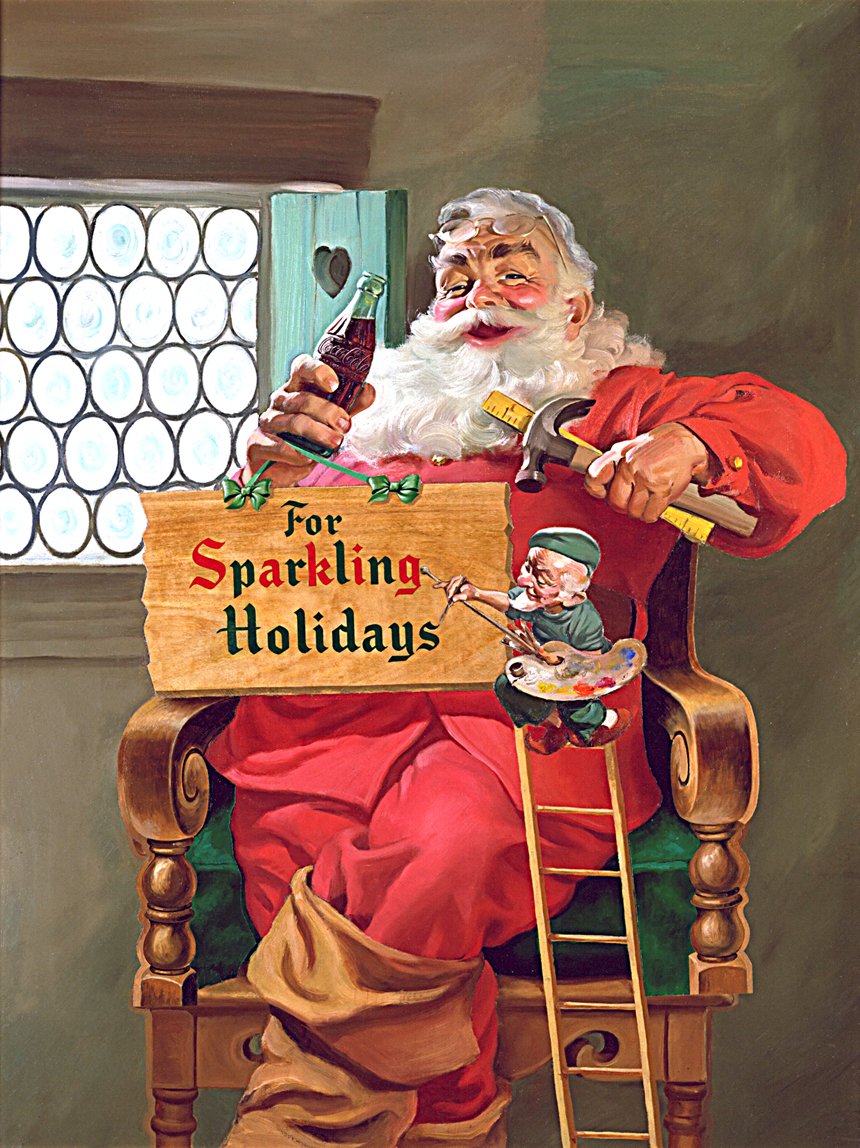
More Haddon Sundblom Santas


Despite the inaccurate statements made by Coca-Cola for a number of years (you have since changed their history) and doesn't look the way Santa create some confusion from other quarters, American Illustrator Haddon Sundblom, as we know it.


This story is a bit less than straightforward and includes a number of other illustrators including Thomas Nast, j. c. Leyendecker, Reginald birch, Norman Rockwell and others (see my post on Illustrator visions of Santa Claus).


However, Sunblom refined one the great illustrators of the 20th century, the image of the character in its most famous form, early. Sundblom's series of Santa illustrations for Coca-Cola show, which ran from 1931 until 1964, gave us the quintessential modern interpretation of the Jolly.


The Coca-Cola page has a selection of some of the pictures and the Coca-Cola art blog has another page here, both with links to larger versions. An even better resource is the post on golden age comic book stories, with many Sunblom Santas in one place (again, click for larger images). There is also a post on KoiKoiKoi.


Leif Peng has an excellent post on sunny's Santa on his blog today's inspiration and has a wealth of other posts on Haddon Sundblom. (Note: some of you include Sundblom's pin-up illustrations which can be mild NSFW.)


See also my previous posts about Haddon Sundbom and Haddon Sundblom's father Christmas illustrations.


I would coal to a piece in my Christmas stocking, however, if it was painted by Haddon Sundblom.


View the original article here

Velazquez portrait wiederhergestellte, literally and figuratively


In 1973, reasons still not clear, the Metropolitan Museum of art me undertook a comprehensive reassessment the many its investments what the demotion of 300 old master paintings from attribution, the master mapping to "Workshop", "Circle" or "followers the", remove the Canon these masters works significantly to reduce of the value of the Museum.


Some of those pieces have again been reviewed both due to the ongoing scholarship and as a result of subsequent cleaning and restoration. Last year met cleaned and restored Velázquezs ' Portrait of a man, and in the process not his original attribution - originating from the master hand child. This was particularly important because the painting has a self portrait (see my post, Velázquez (even?)) Rediscovered portrait).


This process has a painting, it was been repeated once and again, one of the most important paintings of the Museum by the Spanish master which is sometimes labeled all painters of the largest.


In portrait of Philip IV is charged after he was court painter to one of the three court Velázquez. The coating suffered the painting over the years by numerous applications and definite assignment misguided painting was difficult and in a State.


The New York Times has a nice set of interactive to move a slider above the images compare the above their function, the recovery of a Velazquez, and restored state painting (click between the "Restore" tabs and "Two paintings compared" at the top of the feature).


I don't know how long the NYT feature will be available before it registration disappears behind a wall. Painting the listing on the met's website has both a larger version of a zoomable feature, and is still "This information can as a result of ongoing research." change "-tag."


We can expect (or hope) that indulged in Velazquez topic not be flattering here yet. The young Philip, pale, droopy eyes and Red lippy looks more like the dweeb you in addition to sitting in chemistry as a ruler of one of the great empires of the world. But its appearance is consistent throughout the paintings of Velázquez and others, and the master's hand, reveals the distance years accumulated abuse, keeps a steady mirror nature.


(Picture pictures of interactive from NYT on the links, images from the met on the right above)


View the original article here

Colorful holiday show from around the world

Even though a red and green can give an ad that instant Christmas association not all agencies stick with the traditional color palette when it comes to holiday advertising. Some choose a variation, that often includes at least a red or a green, but not always, some create a completely new new holiday palette and only use familiar elements to let you know that it's a holiday advertisement.
Here are few colorful holiday print and video ads, and their color palettes.


The color love in this post was sponsored by HP.


Happy Holidays!

http://www.colourlovers.com/David Sommers has been loving color as COLOURlovers' Blog Editor-in-Chief for the past two years. When he's not neck deep in a rainbow he's loving other things with The Post Family (http://thepostfamily.com/), a Chicago-based art blog, artist collective & gallery.

View the original article here

Walt Kelly's visit from St. Nicholas


The brilliant Walt Kelly, once Disney artists and creators, artists and writers of Pogo, one of the greatest comic strips aver produced, at one point turned his hand to an interpretation (there you want to call it) familiar by Clement of Moore's Christmas poem A visit from St. Nicholas, which many young children know by its first line, "was the night before Christmas".


Kelly's beautiful launches loopy version, infused with a little political satire for its time, the poem:


' Twas of the night before Christmas.
All through the Moon
No creature was stirring
Not even a spoon;


and is too stupid to get from there.


Roger Ebert, jolly old soul has gifted us dashing through their version of the story with the reprint of Kelly's comic strip with Pogo and Albert and high-resolution images (click on that, in the column), with which we extra holiday cheer in Kelly's beautiful pen and ink lines can find included.


[Via masks in life]


View the original article here